Labels

Showing posts with label Critters. Show all posts

Tuesday, March 17, 2015

Fodder

Having ruminants means having to feed ruminants. Having to feed them, especially cows, means having to buy in a lot of hay. I'd prefer my cows, goats, and alpacas eat fresh pasture because if they were wild, that's what they'd do, but let's face it, this is Tucson, this is a desert.

Over the years I've been testing different ways to get pasture to grow. My challenges are doing so with minimal to no irrigation, and finding fodder crops that will tolerate this harsh climate. I've spread different types of pasture seeds all about, sowed fodder beets, fodder corn, alfalfa, and fodder vetch so far. This photo is the vetch. And it's growing everywhere now. The pods are quick to develop so my hope is that it will reseed and that the ruminants will like it and eat it.

Our "pasture" if you can even call it that, consists mainly of wild things like pigweed (wild amaranth) and wild arugula, Malva, and various grasses. The cows really go for the grasses, mowing them off on their walkabouts so the grasses grow in fuller. They do enjoy the wild arugula which is insanely prosperous right now. I had hoped for better with the alfalfa, but it has grown in well next to a garden bed and thickens when it comes back each year, reseeding itself.

This is the first year for fodder corn, and I'm trying Trucker's White, an heirloom variety. They're about 4 inches tall at the moment. Good sign. All parts of the corn plant are edible, and I know my cows like the leaves.

We have substantially less animals than in the past, so feed is not as crazy a cost as it used to be and I'm finding, when the weather cooperates and waters the land, there is so much food available that all I need to do is let the cows at it and they get filled up and happy. Creative solutions and supplements have been the annual surplus of Christmas Trees from tree lots and the tree recycling drop off in town as well as loose hay from the feedstores that often would end up in the garbage because it's not easy to sell. Most people in my area have horses, not cattle and cattle will eat varieties of hay with no complaints.

If you have any fodder seed suggestions that may work in our area, please feel free to comment below.

Thanks!

Friday, March 6, 2015

The Farm Visited a Local School

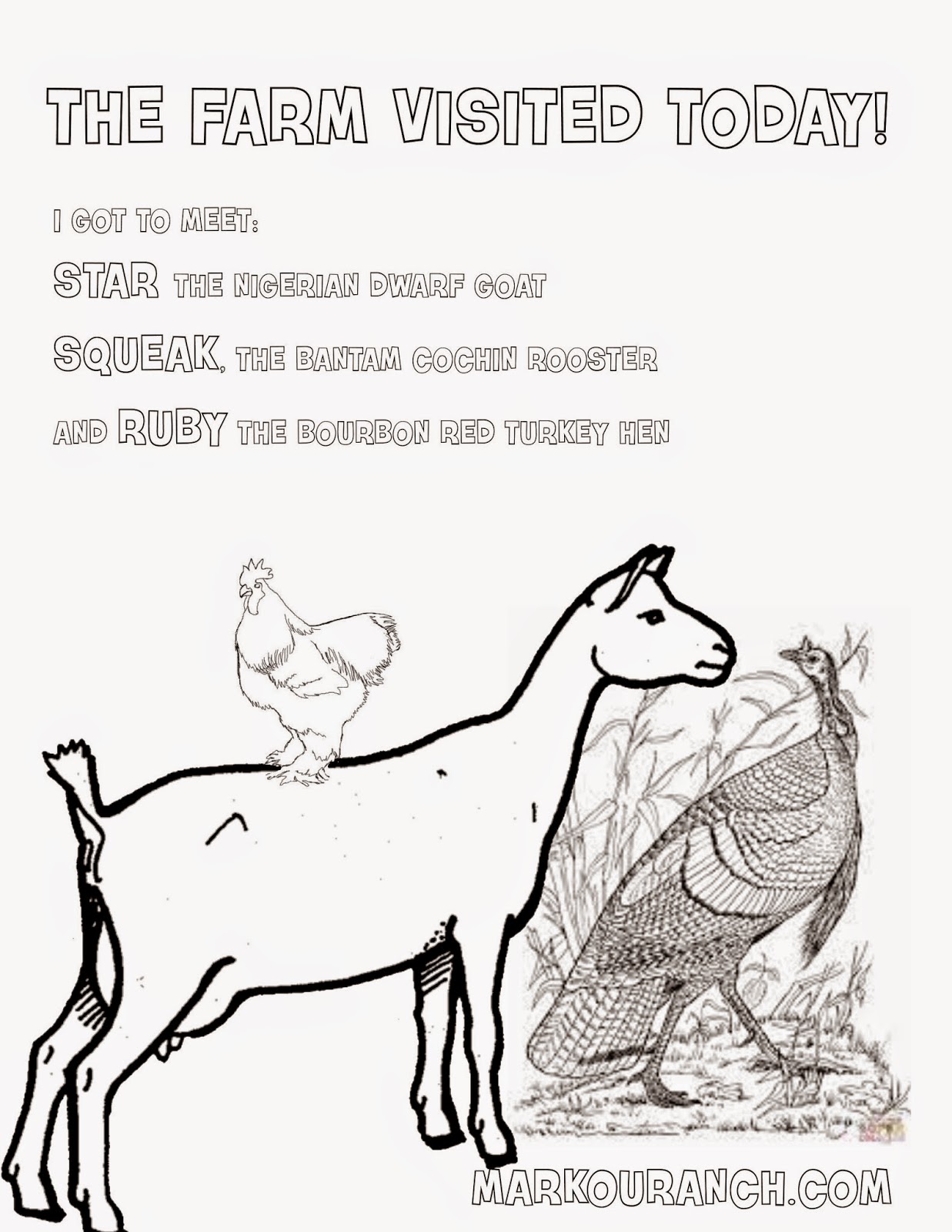
This morning I took Star the Nigerian Dwarf goat, Squeak the bantam Cochin rooster and Ruby the Bourbon Red turkey to visit the preschoolers at Wheeler Elementary school. This is always a big treat for the children as some have never seen farm animals before.

Every critter got petted and some kids even got turkey hugs in return. I talked to the children a bit about why we have goats, what people use goats for and passed around some goat milk soap so they could see. touch, and smell it. Squeak the little rooster was very tolerant of all the attention. He is our friendliest rooster and was on his best behavior. Ruby the turkey really loved all the gentle pets and rubs. She chose two special children from each class to cuddle up to. 

Thank you to Ms. Tami for inviting us again this year!

Thursday, February 26, 2015

From Hobby to Business

It has been seven years since we bought our semi-rural property. Seven years of regrets and waiting, hoping, anxiety and many moments of thinking we would never be able to realize our dream of building a home there. And seven years of work. We are hoping that this year will be the one we can finally put a home there and finish the life changing move we had planned so long ago.

Our priorities have shifted from McMansion to a Minimal home that will be just enough. Our children are older and have had the privilege of experiencing farm life with all of its ups and downs.

We have gone through nice neighbors and mean neighbors and learned many valuable lessons about grumpy neighbors and nosy ones. We have learned that privacy is very valuable. While fences don't make good neighbors, they can certainly make boundaries when we are not present to enforce them with words.

In order to move forward with this plan to have a home there, it's time for the little hobby farm to become a real farm that pays its own way and with luck, also turns a profit. If you follow this blog, please send good vibes our way... 2015 is going to present many challenges.

Thursday, February 5, 2015

Goodbye Lil Red Hen

The majority of our laying hens came from Murray McMurray Hatchery in the mail and I believe it was 2011 that they came to us as day old chicks. We ordered 25 because that was the minimum and we ordered a mixed assortment because I didn't really know what I wanted. We knew there would be roosters in there and we planned to eat them when the time came. Most of them we did. A few were spared and we have one left from that batch--my son's favorite. What I'm getting at is these birds were kinda old for layers. A chicken can live a long life if very well cared for--I've heard up to 12 years, but they stop laying way before then. And our layers are farm hens, no question about it.

They began life here at home in a brooder then when they were old enough, they lived in a chicken tractor at the farm. That way they were safe from predators and able to munch on greens every time I moved the tractor around. Most survived. We only lost one pretty splash hen very young.

The chickens graduated to free range in the goat pen status and lived there quite happily until something realized they were there--probably an owl or hawk. We lost a few to predators and it didn't take long to realize the birds needed to be cooped at night. Later I made the tough decision to pen them permanently for their own safety. Chickens taste good to a lot of predators and they're a fairly easy meal--especially at night.

One of our old red hens, a Rhode Island Red, wasn't doing so well a couple of days ago. She appeared to be eggbound and looked very much like a bloated penguin. I'd seen this condition on the Dr. Pol show and also looked it up in several online forums for recommendations on what to do to try and save her. I cleaned her off and washed out her egg maker slot then put her in quarantine so she wouldn't get picked on. Honestly though, the odds were not in her favor at all. She was very full of stuff and when I came today she was declining and still unable to pass anything.

I made the tough decision to put her down and bury her on the property. I've never dropped the axe on my birds--just rattlers--so it was not an easy chore for me. I brought her to the garden and let her sit in the sun for a while. She looked pretty miserable. I petted on her to keep her calm and stayed with her until her last moments.

I think it's important to understand that when we go into the responsibility of having livestock pets--because that's what the majority of my animals are, we have to accept that we will likely outlive them. Because they are livestock and tend to be high production animals, their bodies sometimes give out too soon. The kind thing to do in this case was not to allow her to slowly waste away and suffer. She had been a good hen and gave my family many eggs over the years. So, goodbye sweet little red hen. You did your job well.

Sunday, October 26, 2014

Cow Butts

Left: Beef, Right: Dairy

Big Rattler

There is construction going on to the west and east of the ranch. That always stirs up wildlife and gets them on the move to new places. Unfortunately for this big guy, taking up residence underneath my camper where my dog naps was not a good choice:

He was 5 feet 2 inches long without his head and he was pretty scary. Max let us know he was there and knew enough not to get bitten. I have never seen a rattlesnake this big in my life and to have it right beneath where I work every day was unsettling to say the least.

Monday, September 22, 2014

September Already?

It's still too hot to be September in my opinion, but Mother Nature doesn't care what I think. Nevertheless, chores need doing and get done despite the toasty days.

I have a lot of fleece that needs to be washed and processed so it can be spun. I have a lot of trash cans turned compost bins cooking up some black gold in anticipation of planting time. And I have a lot of empty garden beds because summer killed everything.

On the bright side, there was this big, beautiful, orange dragonfly sunning itself this morning. That makes everything better, right?

Tuesday, September 2, 2014

Flaming Rope

This THING is a sheep. No really, it or rather she, is a sheepie who missed a shearing. The man who recently bought her and her companions asked me over to shear for him as I wanted the wool and he wanted bald sheep. It worked out.

Unfortunately, this poor girl had to wait two weeks after her buddies were sheared because I did something stupid. If you don't ever have to lasso anything, count yourself lucky. If you do ever have to lasso and you don't know what you're doing, remember rule number one. ALWAYS WEAR GLOVES. It seems simple really. Common sense even. But sometimes you might get really excited because you've got the rope and the sheep is like RIGHT THERE. And you know you can just wham bam lasso that sheep on the very first toss.

But trust me, a rope burn hurts. It can rip off your skin and leave you with blisters and pain for two weeks straight. You'll be real embarrassed about how stupid you were for tossing that lasso even if you did catch the sheep on the first try...

And if you have to shear four sheep after you've burned your hand with a rope and super-glued the fingers over to prevent further pain, you'll soon discover that no amount of dips in a bucket of ice water will stop the throbbing ache and soreness. You'll have to stop hand shearing at sheep number three.

And leave poor sheep number four for the day when your hand heals all up and you can actually use it again for regular day-to-day stuff like grasping a pen, typing on a keyboard, milking your goat or cow--or holding on to the steering wheel of your truck. Let's not even talk about sewing or handshakes. Ew handshakes with a rope-burned zombie apocalypse hand. Gross!

So two weeks later, sheepie number four was quite happy to see me. I think she remembered that I gave out free haircuts. She stood right there, still and eyeing me when I (with my gloves on) gently dropped the lasso around her neck. She didn't even move when I tied the other end to the post. She was a good girl the whole time and it only took me about 20 minutes to baldify her and return her back to her buddies.

In case you forget rule number one, I will be only so happy to remind you via the last picture I leave you with. I couldn't sleep the first night after I received this grievous wound. I had to take pain meds. I had to pop the blisters because it felt like my hand was going to explode. The blisters were ever so much worse than the picture I'll post, because the picture is already a week after the injury.

And I highly recommend keeping superglue handy as an instant bandage. It helped me so much. I wouldn't have been able to shear a single sheepie that day if I hadn't glued the heck out of myself that morning.


RULE #1 of Lassoing: Always wear your gloves.


Saturday, July 12, 2014

Thunder in July

Karma's first calf, a little bull the kids named Thunder, was born right on schedule on the 4th of July amidst early fireworks and gentle rainstorms. We were not present when he arrived, but had apparently just missed it as evidenced by the afterbirth. He is reddish brown, is very healthy and playful. He particularly enjoys the dog, Max. Each on one side of the corral, they play chase.


Since Karma had never been milked before, she has been going through some training to get over her anxiety. She and her little Thunder are in "milk jail" a method that worked for me in the past with goats. I put in a temporary small corral where both are kept beside the milking stall. Karma has never liked the stall and stanchion as she has had to undergo medical treatment in there, shots, tags, tattooing and she associates it with bad things. I tried to coax her into the milk stall with food and even sweet feed would not change her mind. As a last resort, I dropped a lasso around her neck that first time and heaved her in. Instead of closing the stanchion, I tied the lasso to a post and went to work milking. Thankfully, she doesn't dance around like her mother often did and her kicks thus far, are in slow motion and extremely gentle.

Thunder nursed soon after his birth and is a good eater. He is half mini and because Jerseys are bred to make more milk than one calf can take, it's easy to share the milking with him. He takes whatever he needs and I take whatever I need. Karma gets a massive bin of alfalfa, Bermuda and a bit of sweet feed and everyone seems content so far.


I feel as though I am relearning a new skill since every animal is different when it comes to milking. Karma has good front teats and Thunder prefers them, so he's used them and stretched them out a bit. The back teats are harder to milk out, so my guess is that he doesn't favor them as much. I figure he gets the front and I get the back until he can catch up some more.

Thunder is much more curious than Karma was as a calf. He will come right up to us and sniff us, checking out what's going on. Like any baby, he eats, sleeps, and poops a lot. Milking works best when he joins his mama in the stall as she is calmer having him where she can keep an eye on him.

It took a few days for Karma to get the milk routine down. Now she knows what the schedule is and I often find her waiting in the stall for me.

I don't use the stanchion because I think it frightens her. I come in from the front and gently loop the lasso over her horns and fasten it to the post as she eats. This keeps her in place and lets her move her head quite a bit but doesn't allow for her to leave.

She does have a little edema (swelling) in her navel. This began before the birth. I read several articles and it seems to be normal and should go away in a couple of weeks. It doesn't seem to bother her.

Having her in the stall each day has given me the opportunity to try the Dremel on her hooves. When she was a calf, I could easily lift her feet up and trim her hooves like a farrier would a horse. But now that she's full grown, she can simply kick her leg free of my hold and I am not strong enough to hold on. I have to say, the cordless Dremel is a little slower than the nippers, but it works well enough and is much more precise.

It's nice to have fresh cow milk again. I've made butter, pudding, cheese and smoothies. It's so delicious and rich--hard to describe to anyone who has not tried it.

Monday, June 30, 2014

Karma Update


Cookie eyeing me as I snap a pic of her buddy's udder.
It takes nine months of gestation before a calf is born. By my calculations, Karma is due July 4th. I've been doing an udder watch each morning and her milk maker is getting bigger each day. It's interesting to me because her mother's udder was damaged and hung so much lower and lopsided. Karma's is close up to her body and more oval shaped. I suppose a person who doesn't enjoy milking can't appreciate my fascination with udders and teats.

Karma has taken her pregnancy well. She is ever the rascal and I don't think I'll come to completely trust her since she has horns and knows how to use them. She's whacked me with them a few times. As long as I carry a big stick/rake/shovel she seems to avoid me. I use the tools as a shield should she decide I need a good impaling. It should be interesting to see how I'm going to convince her that she needs to share some milk with me...

Since she was a calf, I have rubbed her sides and touched her udder and teats to get her used to the whole concept. She's not bothered by it. She'll occasionally look back at me and then continue eating. As long as I don't try to make her go anywhere or attempt to trim her hooves, she tolerates me.

Karma has a nice womanly figure and looks ready to pop at any moment. In the mornings, she tends to be lazing in the sun in the sandy part of her corral, chewing her cud. She's considerably wider and mellower. She allows me to pet on her more often than she did pre-pregnancy.

Her face is darkening which reminds me of her mother. In fact, if not for the horns, she would look a lot more like Gucci.


I hope I can be there when she gives borth since I missed her birth. Some animals seem to wait until I'm there as if they appreciate a helping hand if need be. Some are sneaky about it, and go .covert, hiding out and silently handling everything on their own. Here's hoping for a girl...


Tuesday, April 29, 2014

2014 4-H Poultry Projects

The kids all did 4-H this year. They stuck with poultry, which in my opinion, is a nice animal project because the birds are portable as opposed to steer or horse project which require trailering.

Christian's showbird from last year died unexpectedly on her nest box and Gabe's showbird was killed by some sort of feline--I suspect it was a bobcat but I have no proof. It could have been a feral cat, judging by the little footprints left in the frost.

Those deaths really put a damper on going forward with poultry.

Nevertheless, Christian decided to purchase a Creme Splash Dutch Cockerel from a breeder. Gabe was determined to show the standard birds we already had. He later found out that he had to do showmanship in order to do breed, so he purchased two bantam chicks from the feedstore. He was also given "Gertrude" an old buff Sebright, from the petting zoo we sometimes help out at. Gertrude was older and mellower, so she became his showmanship bird. The chicks became breed show birds.

Kyri bought a pair of Self-Blue Belgian d'Uccles from the same breeder Christian visited.

And so another year of 4H has come and gone. The kids love their leader, Irish, and she does a great job schooling them on breeds and what's needed to raise chickens. Here are the pictures of the boys and their birds from the Pima County Fair shows:

Farmer G with his Dark Cornish Rooster "Lil Devil" aka "Glare Jr"

Farmer C with his Dutch Rooster "Shimmer"

Farmer K with his rooster "Zeus"

Farmer G showing off his Showmanship ribbons he won with "Gertrude"


Easter Babies

 
I got these babies on April 16, 2014.
The label on their cage said March 25, 2014, so I am guessing that was their hatch date.
 
The are a naked neck, Blue Andalusian, and a Cuckoo Maran.
I really wanted the Maran since they lay dark chocolate colored eggs.
I wanted the naked neck because...it's got a naked neck.
The blue was just because three is a good number of chicks.

Our hens are getting older and we've had losses over the years due to age, predation, and heat (in the larger breeds) so I guess these girls will fill in for the ones that are no longer with us.
 
They're growing like weeds. Literally, visibly bigger each morning than the one before.


Monday, April 14, 2014

Corn, Trees, a Cat, Soap and Pies

It's been a little while since I blogged. Like many hobby farmers, I have a 'day job' that supports my 'habit' and also helps pay the bills for living expenses. I have been busy with that. Also with my children's many goings on: 4H meetings and duties, chaperoning a band trip, shuttling to and from school and soccer practice. Whew.

So if you're wondering what's happening at the ranch, here's a little rundown...

Today I planted heirloom sweet corn. If it's successful, expect a harvest in 76-80 days. If it's not successful, expect the cows to be eating some dried-up, failed corn stalks. I filled in the first two rows in the Three Sisters Garden. I may do more in the other rows soon. That garden is meant to be low maintenance and has some experiments going on to try to conserve water and still get a good harvest.


---
My husband expressed the opinion that there were not enough trees near where we want to build our house (someday--who knows when that will be?). That's true. That section of our property is fairly barren. It's supposed to be the part that's riparian, but it looks like a parched, sad, overheated desert. In general when there is a wind coming through, it comes from west to east and it can be strong enough to knock things over. Since that section of the property is so barren, it can also stir up a vast amount of dust.

The poplar cuttings I ordered from Frank Gomez (http://hybridpoplars.com) are doing so well, and are fast growing trees which (when strategically placed) can be used as a windbreak, so I ordered more. Behold, 100 hybrid poplar trees only about three inches long:

If all goes well tomorrow morning after chores, I'll dip them in rooting hormone, stick them in soil and watch them grow like the magical things that they are. As far as I know, we have plenty of time to grow some windbreak trees to have around our house that isn't there and may not be there for years. Time: waste not, want not.
---
In other news, although we have had no more farm animal deaths by predation, we did manage to capture a FERAL cat. This little guy/girl went off to Pima Animal Care this morning. Just a friendly reminder to spay or neuter your cats so they don't make more and more and more. If you can keep them indoors, do so. It's safer for them than letting them roam where coyotes and bobcats can get to them. Also, it keeps the odds in favor of small farm animals surviving, and limits losses to the native wildlife. Every year we seem to get an influx of feral cats in our area. I'm sure it's new litters born from those clever parent cats that manage to not get picked off by the packs of coyotes. And every year we see the evidence of their carnage on the quail, woodpeckers, doves, and whatever else used to wear all those feathers left in piles here and there. They kill lizards, snakes and many rodents as well. They are survivors.


If you've never encountered a feral cat before, you should be aware that they are not in any way shape or form like the kitties raised with a trust of humans. Feral cats can and will bite you or scratch you. They will do so with all the malice and intent of a wild animal that feels threatened and wants to get away from you. Don't reach down and pick up a feral kitten. It will bite right through your finger. True story. 

I wished the kitty good luck on his/her journey, but it probably will not be a happily ever after. This cat was older and did not like people at all.
---
I made some lavender soap. I was experimenting with a different kind of oil. It came to trace faster and hardened faster than what I usually use. I waited too long to cut it and was sad that much of it broke apart.  It's still going to be good soap but won't be as easy to sell since it's not in uniform shapes/weights.

--- 
I have been ever diligent about my manure maintenance plan and have discovered new ways to make the process easier. I may write a whole separate article about the process I use to get poo turned into black gold when I have more time. In the meantime, there are daily sweep and shovel parties as well as pie hunts in the cow corral:


Thus, I shall leave you with the above happy picture. 
Remember, if life gives you poo, make compost and grow flowers.
Chase your dreams and work hard. At least you will lead a full life.


Thursday, March 6, 2014

Greenhouse and Critter Update

Some plants have moved out into the garden. Some are still waiting, tapping their roots and rolling their buds at me when I don't choose them to move out. Most are ready to go. Some are still too small and delicate.

Here are some pictures of what's happening in there.

These little sticks have been fascinating to watch. They seem to grow right before my eyes. They came from Frank Gomez who runs http://www.hybridpoplars.com/ and have, so far, lived up to the claims about them.

This tray contains starts of marigold, African daisy (none have germinated), green beans, and corn. I like these Jiffy peat pellet greenhouse trays as I tend to have success with germination. I don't like to plant a bunch of seeds and have to thin out plants. The pellets can be reused if a seed didn't germinate in them.

Last year I sowed zucchini seeds directly in the plots. Some grew, some didn't. I wanted to try starts this year to be sure that all areas were evenly covered. Here you can see half success on germination.

The most difficult to germinate are the bell peppers. I'm really not sure why. They are new seeds and out of 72 it looks like about 12 have started. Very dissappointing.

For those that check this blog for animal updates, the critters are doing fine. I'm still milking my Alpine and my Nigerain goat, although I'm drying off the Nigerian. I don't think the Alpine will dry up easily as she has not slowed at all in her production. She's a good girl and loves to be milked. Now that she is the biggest goat in the pen, she has claimed the matriarch position. She is not good with human children, so it would have been difficult to sell her to a family who wanted a milker. Most people wanted to eat her when they saw her, which to me, seemed a huge waste for such a prolific milker.

My pregnant cow is developing a lovely rounded bag. I am a little frightened since her mother, who only had three good teats, was a prolific milker. Four good teats is well...gonna mean more milk. Since her calf will be half mini, I wonder how much milk it will take. Jerseys have been bred to make more milk than a calf needs and my cow will need milking twice a day. She's a feisty girl and always has been. But today, she let me rub her all over and even touch her udder. She will need milk training and that will likely start soon. The cow corral was moved some time ago and it's not in the best location relevant to the cow milking area. My cows are not halter trained and not good at taking directions unless they are very hungry and feed is in my hand. Even then, I do not completely trust my Jersey. She has horns and she knows how to use them on anyone who isn't doing what she wants. It's never a good idea to piss off an animal that can squash you.

The alpacas are fine as well. Quiet, peaceful, not a bother. They need a nail trim soon which will require a child to hold the halter while I wrestle with making the alpaca realize I'm not going to hurt them. My goal is to get their fleeces from last year spun before I sheer them this year. It may or may not happen. Some fleeces are dirtier than others. They were sheared in May last year before they came to us. I had contemplated hand shearing but I'm not that good at it and the fiber is so freakin' awesome that I would hate to lose length by doing a bad job. I will likely have the same shearer come out to get things done as she was very efficient. My one alpaca with the face wound has cleared up for the present. He wears a fly mask to protect him from the nasty buggers which as yet, have not been too bad. I do think he'll be needing his front teeth trimmed this coming year as they are quite bucky, more so than any of the others. That is another thing I will need help with.


Wednesday, December 11, 2013

2013 Reflections and Warnings for Future Hobby Farmers

Another year has come and nearly gone and we still don't have a house on the land we originally purchased to move to 'the country'. Turning the land into a hobby farm because we were unable to build has been a many faceted learning experience. We have tried to see what will work and what does not work and are constantly reevaluating 'the plan'. There never really was a' plan' which I have learned was the first of many mistakes. So, if you want to farm in any way shape or form, you should make a plan before you begin. A good, strong, detailed plan. And be aware that your plan will change anyways. But you should have a starting point.

City folk won't have the basic knowledge years of farming creates, knowledge that gets passed down through generations, so we must learn from books or by doing. Especially if there is no one nearby that can share farming knowledge.

Animal Changes
My goal has always been to strive for sustainable farming. Buying in feed for animals is not sustainable or cost effective in the long run. For many reasons, we have decided to downsize on animals and focus on plants. While we will still retain a limited number of livestock for pets, milk and manure, I no longer want to raise meat animals. To do so in a method that makes sense, we would need pasture and the land and the limited Tucson rainfall does not naturally support that kind of growth.

Shifting focus to intensive vegetable gardening has brought about raised beds and deep raised beds, more intensive composting, and a whole other massive sized garden. Pasture seed has been scattered anywhere and everywhere else it could possibly sprout and I await spring with bated breath and high hopes. Not for the first time. There will most likely not be enough pasture to support the limited livestock, but I am crossing my fingers still.

I have looked back over this blog to the beginning of this adventure and found that the saying "Chickens are the gateway drug to other farm animals" to be very true. Of course, my first chicken was a feral pigeon...but that's another story. This whole crazy idea started with a few backyard chickens. You have been warned.

Farm animals are unique in that most people keep them because they serve a purpose, or many purposes. In evaluating the most useful farm animal, I vote for the noble goat. A goat can clear unwanted vegetation, trim trees and small branches, give fresh milk which can be made into cheese, yogurt and soap, provide meat in the form of her offspring, carry small burdens, entertain, comfort, and will accept hugs as well as give them in her own goatly way. Goats are also cute and can learn basic verbal commands. You have been warned again.

Most often overlooked by those who raise animals for meat is the animal's intelligence. I have seen people who have no respect for the animals--especially when they want to eat them. Throughout this farming adventure, I have seen time and again that animals deserve a kind hand and compassionate treatment whether they are destined for the dinner table or not. They deserve respect. I hope that those I sold have found a place where they are treated with the same respect and kindness I showed them.

I don't recommend cows but I'll keep mine, thank you very much. They are gigantic beasts and get excited easily. Their steering and brakes don't work all that great when they're happily skipping and running toward a person. They can be stubborn and their sheer strength makes that an obstacle when they need basic care. But as my vet, Doc Mary, once said, "Cows are fun." They can be hulking, ginormous, earth thundering fun. True.

Sheep are too flighty and skittish for me. I loved my Muffy most of all because she was old and covered with wool and she loved to eat and would let me pet her. She was a challenge. She taught me to spin and want a spinning wheel. She was my gateway drug to alpacas. But sheep are not for me.

Ducks came because my oldest son has always liked ducks. He was the only one who mourned when they moved away. Ducks are a high maintenance bird, especially in the desert. They make big, nice eggs great for baking, but ducks too, are not for me.

I miss the geese, but I am the only one who does. Geese are not for my family. They are however, excellent watchdogs, weeders and makers of huge eggs. If I had a large pond and a larger acreage and my family all lost their hearing, I would totally have two geese again. I prefer geese over chickens, but it's obvious by now I am a little touched in the head.

The alpacas make the best yarn. They were not tame when they came to us, but they're getting there. Because they are fairly exotic here, their care can be a challenge if something odd comes up. But I like them. They don't have to die to make a product. They're peaceful and quiet. Best of all their pellet shaped poops are all made in one communal pile for easy cleanup. People who don't clean up after farm animals can't appreciate that last statement to its fullest.

So we have downsized to alpacas, cows and a few goats. Cows have goats beat on milk production and manure production although goat manure is far superior and easier to manage. What can I say. I love the goats and the goats love me, ever so much more than the cows or alpacas ever will. Cows and alpacas tolerate me. They could care less whether I tend them or not. They find me annoying. Goats like to hang out with me. Cows and alpacas hang out only if I have food. Then they go away because they don't think I'm that cool.

Milk Changes
Selling raw milk is, quite honestly, a pain. I milk by hand. I drink my animals' milk raw. I'm happy with that. I like to make cheese sometimes and soap sometimes. There are many regulations regarding the sale of raw milk that I don't really want to mess with. So, I generally don't sell milk. And I'm okay with that. A person really can't appreciate milk until she has to milk her goat or cow every day, morning and night, without fail. I would be the one crying over spilled milk because my Popeye muscles were made from milking day in, day out for the past couple years. I love milking. It's a time to sit and focus on nothing at all but the task at hand. It gives my mind a break. There is something timeless about it that connects a person to the past. I'm happy just milking for what my family needs or maybe our friend Koulis since he likes to play and make cheese and yogurt, but that's the extent of my milking prowess.

Egg Changes
The only laying fowl we have retained are the flock of chickens. They make eggs for us and the restaurant. If we manage to have surplus, friends and family might get some, but these hens are slowing on their production and one day, I'd like to just have three hens again. Three was enough. Since all the kids are in 4H poultry, it may be a while before that happens.

I am hopeful that 2014 will bring about better things for everyone, that our economy will recover and people will get back on their feet. Driving past so many closed businesses in Tucson is still gut-wrenching. The mortgage losses and foreclosures--devastating.

So, I don't have a house in the country, but I have years of useful knowldege, fond memories, painful memories, the memories of really good food and time well spent doing hard work, the kind of hard work done just for fun, not for profit. Markou Ranch is a hobby farm, not a business. It is in existence because when I was five years old, I wanted to be a farmer when I grew up. Each experience has taught me something, good or bad, that I will carry forward, and one day I hope I find that special house in the country to come home to, whether it is on this little plot of land or not.




2013 Photos in Review

Calf scales, not just for calves...

 
Nothing like a warm fire on a cold night.
 
Tomatoes in November. Mmm.
 
Donation to the Community Food Bank provided by the sale of a goat.
 
Some neighbors don't like a crazy goatlady...
 
Pumpkins prevailed in the Three Sisters Garden!
 
Goodbye to Ms. Cow, Barbie, Espresso, Starlight, Starburst, Stardust, Paprika, Violette, Salt, and Vicky. Last run of the goats before a major downsize.
 
Goodbye ducks.

Hello Raised Beds and Big Eggplants!
 
Thanks for helping, Mom!

Super useful and compact hay shed for the alpacas.
 
My spinning wheel with alpaca yarn in the making.
 
Piper having breakfast.


Yearly Kingsnake Visit.

First Potato Harvest


Goodbye Geese.


Exploring New Methods to Feed the Flock.